
Event Review - Spires and Shires 2021
Some races are about times, splits, and performance. Others are about the experience.
Spires and Shires sits firmly in the second category.
From the moment you arrive at Naseby Playing Fields, there’s a different feel to it. Registration takes place in a simple pavilion — well organised, friendly, and quietly efficient. There’s no big-race tension, no crowds pressing forward, no sense of urgency. It feels relaxed, almost understated, which is exactly how the day unfolds.
This isn’t a race you rush. It’s one you settle into.
That becomes clear fairly quickly, especially if — like me — you don’t quite get the navigation right.
The route is provided via a QR code, which you’re expected to load onto your phone or GPS device. It’s straightforward enough, assuming you come prepared. I didn’t. I’d forgotten my glasses and decided, somewhat optimistically, that I could just follow other runners and muddle through.
That lasted all of about a few miles.
Before long I’d drifted off course, then corrected, then drifted again. By the time I found myself in Long Buckby asking locals for directions, I’d already added a couple of extra miles to the day. In a different race, that would have been frustrating. Here, it didn’t really matter. With a nine-hour cut-off, there’s space to make mistakes, reset, and carry on.
In fact, that time allowance changes the whole nature of the event. You’re not chasing the clock. You’re moving through the landscape, dealing with what comes, and enjoying it for what it is.
And what it is, is beautiful.
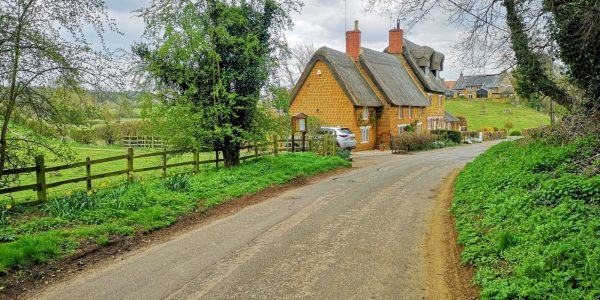
Northamptonshire doesn’t always get the attention it deserves, but out on this course you begin to understand why it’s sometimes called the “Rose of the Shires” or even the “Second Garden of England.” The route winds through rolling countryside, past warm stone cottages with thatched roofs, across open farmland and into quiet, unhurried villages. There’s a sense of stepping back into something older, something slower.
You pass the Country Houses of Holdenby, Althorp (home of the |Spencer Family), and Cottesbrooke, threading your way through charming villages such as East Haddon, West Haddon, Crick, and Thornby. Each has its own character, its own rhythm. East Haddon, in particular, makes sure you’re paying attention — the climb into it is one of those sections that reminds you this isn’t just a gentle wander.
The terrain keeps you honest as well.
This is proper multi-terrain running. Fields, tracks, trails, bits of road — and, depending on the weather, plenty of mud. Northamptonshire clay has a habit of clinging to your shoes and building up with every step until your feet feel twice as heavy as they should. It’s not technical, but it’s demanding in its own quiet way.
Trail shoes aren’t optional here. They’re essential.
The year I ran it, the conditions added another layer. It was unexpectedly warm for late April, and the combination of heat, distance, and terrain began to take its toll. At one checkpoint, when a marshal asked if I wanted water, my response was immediate: “Yes please — just throw it at my face.” It wasn’t entirely a joke. That moment of cold water was exactly what was needed.
Support on the course matches the tone of the event — not intrusive, but always there when you need it. Marshals are friendly, approachable, and genuinely helpful. It feels less like a race operation and more like a group of people making sure you’re alright.
One of the more interesting aspects of Spires and Shires is that the route alternates direction each year, running clockwise one time and anticlockwise the next. It gives the course a different feel, a different set of challenges, and quietly invites the question of which direction is tougher. It’s also a good excuse to come back.
Which, despite everything, I did.
You might think that after getting lost once, I’d be a bit more careful the second time. You’d be wrong. When I returned to run the Three Quarter Marathon, I managed to go off course again — this time far enough that I received a phone call from the Race Director asking where I was. At that point, there’s not much to do but laugh, accept it, and find your way back.
And that, in a way, sums the race up.
Spires and Shires isn’t about precision. It’s not about perfectly executed pacing or flawless navigation. It’s about being out there, dealing with what comes, and enjoying the process. It asks a little more of you than a standard road marathon — a bit more awareness, a bit more adaptability — but it gives something back in return.
It gives you space.
Space to run, to think, to get lost occasionally, and to find your way again. Space to notice the landscape, the villages, the quiet details you’d miss in a more crowded, structured event.
Would I do it again?
Yes, without hesitation.
Not because it was perfect — it wasn’t, and that was down to me — but because it felt real. It felt like a proper day out in the countryside, one that happened to involve running a marathon along the way.
If you’re looking for a race where the experience matters more than the outcome, where you’re part of the environment rather than just passing through it, then this is one worth trying.
Just don’t forget your glasses.
For more details head over to the Go Beyond Challenge website and get yourself booked in for next year