
Why Trail Running Feels so Different from Road Running
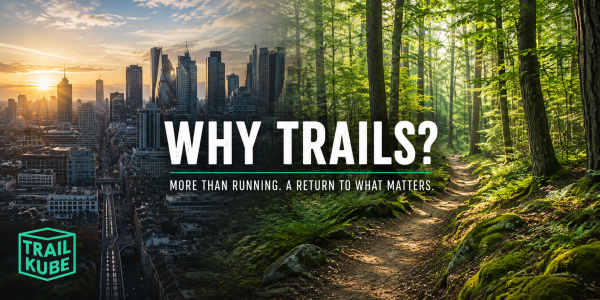
“Modern life is built around straight lines. Nature isn’t.”
That’s usually my answer whenever somebody asks why I spend so much time running through forests, hills, mud, rain, rocks, roots and places that most people would probably describe as “hard work”.
Because the truth is, trail running feels very different from road running — and I don’t just mean physically. It feels fundamentally different. Mentally, emotionally.
Don’t get me wrong, road running absolutely has its place. I still do a lot of it myself. I live in town and runs in the countryside after work aren’t often possible. It’s accessible, simple, efficient and for many people it’s precisely where running starts. There’s also something rather simple about just putting shoes on and heading out of the front door.
But trail running seems to tap into something much older and much deeper. And I think it all starts with the world we now live in.
Most modern environments are dominated by straight lines:
- roads
- office blocks
- desks
- screens
- walls
- schedules
- rows
- systems
Everything is controlled, measured, timed and organised.
Nature isn’t like that.
Forests curve, trails twist, branches bend and twist in the wind, which itself whips around in all directions. You won’t find an arrow straight river anywhere, and mountains rise unpredictably.
Nothing is perfectly symmetrical or manufactured.
And I genuinely think the brain responds to that.
Whether we realise it or not, humans evolved in natural environments for thousands of years. We lived and roamed in open spaces, forests, in ever changing terrain. Weather, movement and unpredictability were normal life — not something we occasionally visit on holiday.
Sadly, modern life has moved us away from that incredibly quickly.
Trail running often feels like stepping back into the environment our minds and bodies were originally designed for. You notice it almost immediately once you leave the roads behind.
The sounds change first. Traffic disappears within a few yards of the roadside and suddenly you become aware of birdsong, wind through trees, babbling streams and quite often, just silence
Then come the colours. Greens, browns, the sunlight breaking through trees. Look up and there are open skies, mist covered hills and the beauty of the morning frost on winter runs.
Even the air somehow feels, tastes, and smells very different.
OK, some of this might sound overly slightly poetic, but there’s some real science behind why people often feel calmer and mentally lighter in forests and natural spaces.
Trees release these amazing compounds called “phytoncides” — natural oils produced by plants and trees as part of their own protection systems. Studies around “forest bathing” and time spent in woodland environments suggest these compounds may help reduce stress hormones, improve mood and even support immune function.
In other words: being around trees genuinely seems to be good for us. I know I can feel it. Don’t we all fell a little boost when we go for a walk in the woods?
It’s all down to those “phytoncides” acting on the brain, helping it to operate in a more natural rhythm again.
Modern life rarely gives us that.
Most people now spend huge parts of their lives staring at screens, multitasking constantly, switching attention every few seconds and carrying low-level stress almost permanently.
Trail running cuts through that surprisingly quickly, and it’s often because trails demand your attention. On technical terrain, you really have to concentrate. If you don’t, you’re going to trip over some rock, root or tussock. Stop paying attention and you’ll faceplant! I’m sure I’m also not the only one of us who’s been nearly pole-axed by a startled deer leaping out of a hedgerow.
But that concentration is actually one of the great hidden benefits of trail running. This is because, for periods of time, your mind has no choice but to stay exactly where your feet are. All you think about is one step at a time, planning three steps ahead. That “Executive Summary” your boss needs on his desk on Monday morning? Out of mind – totally. Gone.
Trail running creates periods where the brain finally seems to quieten down naturally. Everything shrinks to the irrelevant, except just BEING.
No apps, no deadlines, no pressure. Just movement, environment and focus.
Physically, trail running also feels very different to road running.
Road running is repetitive by nature.
The same stride.
The same impact.
The same movement pattern.
Over and over and over again. And again. Ad infinitum it seems.
Trail running constantly changes:
- stride length
- cadence
- foot placement
- body position
- through climbing
- descending
- using your balance
- it’s a full body experience
You’re not simply moving forwards, you’re adapting continuously.
And I suspect that’s one reason many trail runners seem to suffer fewer repetitive stress injuries compared to those who pound the pavements through years of heavy road mileage.
The body was built to move dynamically, and not like the machine we treat it like on even (occasionally not so even) tarmac. And tarmac is HARD, even compacted soil is forgiving, and our feet, ankles, knees all notice that. They just hurt less after a run – usually!
One of the other things I really like about trail running is how little clocks really seem to matter. Of course races have timings and cut-offs and people still challenge themselves, but compared to road running, the obsession with pace often disappears surprisingly quickly once trails, hills and terrain enter the equation.
Nobody really cares about your pace. It’s simply being out there and enjoying the experience that matter. That’s what’s important. For me, nothing else is.
These are the questions I get asked at the end of a trail event:
Did you enjoy it?
Did you see incredible places?
Did you have an adventure?
And I like that. A lot!
Trail running also has one of the least ego-driven cultures I’ve ever experienced in sport. There’s a strong understanding that everyone is enduring something difficult together, and difficulty is a great leveller.
On trails and ultra events you’ll find people from all walks of life. Young and old (that’ll be me then). Professionals and students. Great runners and back-of-packers. It’s a right old mix, and that’s a great thing because out there nobody cares what car you drive, how you earn a living, whatever. You’re all just runners trying to get through the same climb, the same mud, the same rain and the same suffering together.
People look out for each other too.
I’ve seen runners stop to help strangers with injuries and share food. In past races I’ve stopped to check on exhausted competitors, even “carry” them to the next checkpoint. We’ll offer encouragement in horrible conditions, and celebrate everyone crossing the finish line. There’s true camaraderie in trail running that I can’t say I’ve felt so much in road running. That’s all a bit “heads down and RACE” for me.
And perhaps that’s because trail running strips life back down to simpler things. There’s nothing artificial about a forest or a desert, There’s nothing manufactured. Just people out in nature doing something difficult together.
Another beautiful thing about trail running is that it scales endlessly.
You can:
- jog local woodland paths
- enter a relaxed 5k trail race
- run a local half marathon
- disappear into mountains for multi-day adventures
There’s room for everybody, and trail running also changes travel completely. You don’t experience places as a tourist anymore. You experience them through movement, and as a result trail running is an immersive experience rather than a man-made one. I know I get the feeling that I’m part of the environment rather than an interested observer. But don’t get me wrong, trail running can be rather hard. Sometimes very hard.
There are moments where your legs WILL hurt, the weather closes in and you can’t se more than a few feet ahead through the sleet, where climbs feel endless and motivation all but disappears
It’s at times like this that we find ourselves questioning our life choices. But somehow the rewards always seem bigger too, and always, always, worth it.
The smiles, the views, the shared experiences and the endless stories afterwards.
Maybe that’s why so many people fall in love with it once they try it. After all, it reconnects people to something very old and very real.
Nature. Pure and unadulterated.
And perhaps that’s why trail runners keep going back to the woods, hills and mountains again and again.
Not to escape life.
But to feel more connected to it.